
Reviewed · HERCULANEUM RUINS TRIPS
Transfer from Naples to Positano with 2 hours Private Tour in Herculaneum
In This Review
- Naples to Positano, with ancient ruins in the middle
- Key things to know before you go
- Naples to Positano without the bus and train headache
- Why Herculaneum is a smart use of your time
- Meeting point and the start at Parco Acheologico di Ercolano
- Casa dei Cervi, Balbo’s terrace, and the houses that teach you to look
- Casa dei Cervi (about 15 minutes)
- La Terrazza di M. Nonio Balbo (about 15 minutes)
- College of the Augustales (about 15 minutes)
- The domus sequence: wooden partitions, skeleton house, and luxury entrances
- Casa del Rilievo di Telefo (about 15 minutes)
- Partem Domus lignea, Casa del Tramezzo di Legno (about 15 minutes)
- House of the Skeleton (about 15 minutes)
- Central Thermae (about 15 minutes)
- Casa del Salone Nero (about 15 minutes)
- Samnite atrium, a balcony courtyard, and the Grand Portal finale
- Casa Sannitica (about 15 minutes)
- Casa del Bel Cortile (about 15 minutes)
- House of the Grand Portal (about 15 minutes)
- Timing and how the day actually flows
- Price and value: what you’re really paying for
- Who should book this (and who might want a different plan)
- Should you book the Naples to Positano transfer with Herculaneum guide?
- FAQ
- What is included in the Herculaneum visit?
- Where do we meet the guide for Herculaneum?
- How long is the overall experience?
- How long is the Herculaneum guided portion?
- Is pickup available in Naples?
- Do I need to pay separately for entry tickets?
- Is this tour private?
- Are meals included?
- Are car seats available?
- Can I bring a service animal?
- What is the cancellation policy?
Naples to Positano, with ancient ruins in the middle
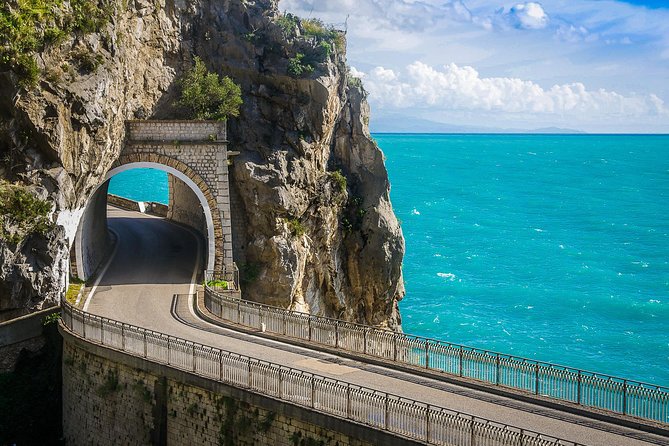
This is a smart way to move along the Amalfi Coast without losing your day to transit, and it adds a guided stop in Herculaneum. What I like most is the door-to-door private transfer with an air-conditioned minivan and a professional driver, so you can relax from Naples straight to Positano. Second, the Herculaneum portion is guided by an archaeologist, with quick, high-impact stops that help you understand what you’re looking at. One drawback to consider is that it’s a fast-moving ruin tour with short stop times at each site, so it rewards focus over lingering.
The best part is the pacing: you get guided context for about a two-hour window in the ancient city, then your driver handles the vehicle and your bags while you tour. Past guests specifically call out how smoothly the transfer runs and how strong the historical explanations are, including one guide named Laura.
If you’re the type who wants to see more than one big “thing” in a day, this combo makes a lot of sense. You’re basically pairing transportation with a Roman archaeology lesson, while keeping your logistics simple.
More Tours in Positano
- Private Amalfi Coast Boat Trip from Positano, Praiano or Amalfi
★ 5.0 · 431 reviews - Small Group Day Trip to Capri from Positano or Praiano
★ 4.5 · 354 reviews - Capri in a Day from Positano by Premium Boat Tour + City Visit
★ 4.5 · 343 reviews - Very Small Group Capri Boat Excursion with Transfer from Positano
★ 4.5 · 334 reviews
Key things to know before you go
- Private, door-to-door ride from your chosen spot in Naples to hotel drop-off in Positano
- Air-conditioned minivan with a professional driver and luggage help
- A real Herculaneum guide (archaeologist-style) for about two hours on site
- A tight, stop-by-stop itinerary at key ruins, houses, baths, and monuments
- Entrance structure is covered: Herculaneum entry is included, and multiple stops are listed as ticket-free within the visit
- Mobile ticket delivery and confirmation at booking time
Naples to Positano without the bus and train headache
The usual Amalfi Coast plan often turns into a juggling act. Schedules shift, platforms are crowded, and you spend time coordinating connections. This experience avoids that by handling the whole Naples-to-Positano transfer in one private booking.
You choose your pickup time and location in Naples, and you get a one-way private transfer in an air-conditioned vehicle. That matters because once you’re on the coast, you want your energy for the views and the walks, not for standing around waiting. The vehicle is designed for comfort, and it’s specifically set up for travelers with luggage, since the logistics include moving your bags and keeping the tour running smoothly.
The private format also helps with flow. Only your group participates, so you are not stuck matching your pace to strangers who arrive late or ask a lot of extra questions at the same moment.
One more practical detail: the driver stays with the vehicle while the guide runs the Herculaneum tour, and you don’t have to worry about carrying luggage through the ruins. That turns the day into something less stressful than the typical “park your bags, sprint to the entrance, and hope you’re back in time” routine.
Why Herculaneum is a smart use of your time
If you’ve already planned to visit Pompeii, Herculaneum is a great counterbalance. Pompeii often gets the big spotlight, but Herculaneum gives you a different feel and a more compressed, focused look at daily Roman life.
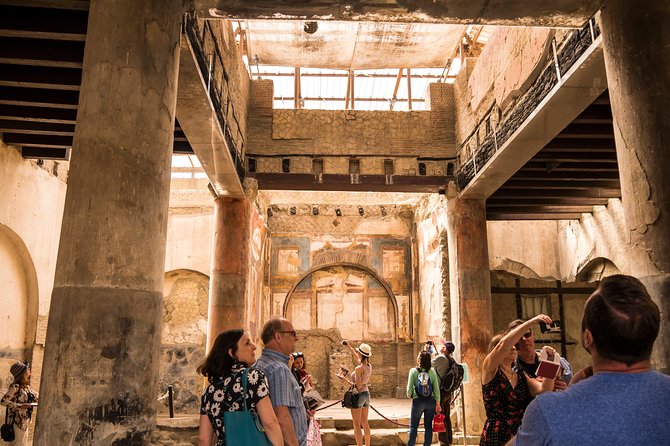
This itinerary is built around a two-hour guided experience in Herculaneum, which is perfect if you want real context without dedicating a full day. You’ll move through major highlights tied to specific houses, public spaces, and bath areas. Each stop is chosen to explain something concrete, not just point at walls and call it a day.
And the ruins themselves offer details you can actually visualize:
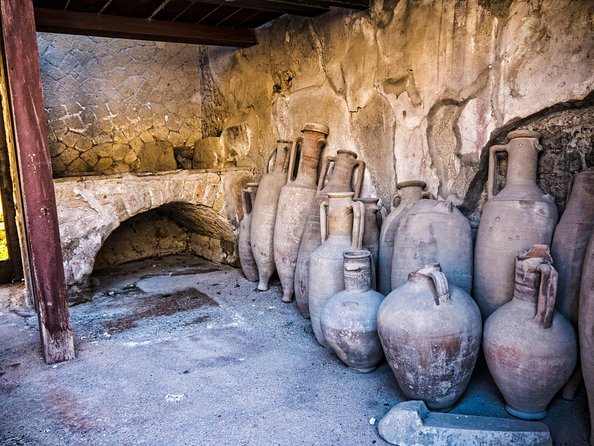
- You’ll see references to charred remains of wooden parts in the house stops.
- You’ll hit places named for what was found there, like deer statues in one domus.
- You’ll learn about social life through the bath setup, including how men and women baths worked with separate entrances.
That’s why this works so well alongside a transfer. You’re not just changing locations. You’re turning transit time into a guided archaeology lesson.
Meeting point and the start at Parco Acheologico di Ercolano
Your Herculaneum visit starts at the Parco Acheologico di Ercolano. You meet the guide at the ticket office at the ruins, and the entry ticket is included as part of the experience. This is not a vague “meet somewhere nearby” situation. You have a clear starting place.
The first stop is short, about 10 minutes, and it’s mainly about getting you inside and oriented. That brief start time matters, because once you begin moving through the site, the guide can connect what you see to the story of the buildings and the people who lived there.
From a practical point of view, starting at the ticket office also helps you avoid a common headache: arriving on site without knowing where to collect tickets or how to get into the right area quickly. Here, you’re guided from the beginning.
Better preserved than Pompeii, and quieter
- Pompeii Herculaneum small group tour from AmalfiCoast★ 4.5 · 12 reviews
- Half Day Herculaneum and Pompeii Tour from Positano★ 5.0 · 1 review
- Transfer from Positano to Naples with a 1 hour stop in Pompeii or Herculaneum★ 5.0 · 1 review
Casa dei Cervi, Balbo’s terrace, and the houses that teach you to look
After you get in, you start with house and monument stops that are designed to make you notice specific clues.
Casa dei Cervi (about 15 minutes)
This house receives its name from marble statues of stags or deer found in the peristyle. That’s a neat example of how Herculaneum naming works: it’s not about modern labels, it’s about identifying features discovered during excavation. You end up looking for the peristyle concept, the layout of the home, and what it suggests about wealth and display.
A short visit here can feel like a sprint, but it works when the guide points out the exact detail behind the name. You leave knowing what the house is called and why.
La Terrazza di M. Nonio Balbo (about 15 minutes)
This stop connects the built environment to a specific benefactor. The name ties to M. Nonius Balbus, described as the city’s major benefactor who restored and built public buildings. The key detail is the long inscription on his funeral altar, which explains his honors.
This is the kind of stop that gives you “oh, that’s why this matters” understanding. Even if the terrace itself is not enormous by today’s standards, the inscription link tells you how public status was expressed.
College of the Augustales (about 15 minutes)
Here the focus turns from private life to organized religious or civic activity. The building is thought to have been a center for the cult of Emperor Augustus, and it may have served as the headquarters of the Collegium Augustalium, with a possible connection to local civic leadership.
In plain terms, this stop helps you see that Herculaneum wasn’t only homes and baths. It had structured institutions and a political-religious layer that shows up in architecture.
If you like the idea of Roman power being visible in buildings, this stop is one of the more satisfying ones in the set.
The domus sequence: wooden partitions, skeleton house, and luxury entrances
This itinerary then moves through a sequence of house stops that keep shifting the theme: household design, unusual layouts, discoveries made by excavation, and the luxury level of the people who lived here.
Casa del Rilievo di Telefo (about 15 minutes)
This house is possibly connected to Marcus Nonius Balbus, and it has a standout layout feature: private access to the adjoining Suburban Thermae to the south. That’s a big deal for what it implies about convenience, status, and how people used bath space.
Partem Domus lignea, Casa del Tramezzo di Legno (about 15 minutes)
This is one of the more unique stops because it centers on the elegant wooden partition that remained. Wooden elements surviving in a ruin site is the kind of detail that makes your visit feel more personal and specific, not generic.
If you like archaeology details that you can picture, this stop is memorable.
House of the Skeleton (about 15 minutes)
This house is named for human remains discovered in a second-floor room in 1831. That turns the site from “architectural tour” into something with a human story behind it, even though the visit time is short.
It’s also a reminder that excavation findings shaped the labels we use today. The guide’s job here is to keep it respectful and factual, and these short stops can still do a lot if the guide points you toward the right interpretation.
Central Thermae (about 15 minutes)
The Central Thermae were built around the beginning of the 1st century AD. The key operational detail is that baths were divided for men and women with separate entrances. That’s a useful concept because it changes how you interpret rooms and circulation.
This is not just “look at old baths.” You learn how the site was organized for daily routines and social rules.
Casa del Salone Nero (about 15 minutes)
This is described as one of Herculaneum’s more luxurious mansions. The monumental entrance is noted for carbonised remains of doorposts and lintel. That’s a powerful visual clue, because it preserves the feeling of an entrance that once looked impressive and solid.
If you’ve ever walked through a modern house and thought about thresholds, this stop gives you an ancient version of that idea.
Samnite atrium, a balcony courtyard, and the Grand Portal finale
The last set of houses keeps the theme of design and status, but with different architectural flavors.
Casa Sannitica (about 15 minutes)
This house has an arrangement typical of the Samnites, described as the ancient people who occupied the mountainous part of central Italy. The atrium is skirted by a gallery with Ionic columns, and the rooms are decorated with frescoes.
This is a satisfying stop if you enjoy the idea that styles vary by cultural influence. Even in a short visit, you get vocabulary: atrium, gallery, Ionic columns, fresco decoration.
Casa del Bel Cortile (about 15 minutes)
One of the original houses in Herculaneum, this stop highlights a courtyard with a stairway and a stone balcony instead of an atrium. That changes how the house functions spatially.
This is a good example of how Herculaneum can surprise you. Not everything is the same “Roman house formula,” and the guide can help you see the differences clearly.
House of the Grand Portal (about 15 minutes)
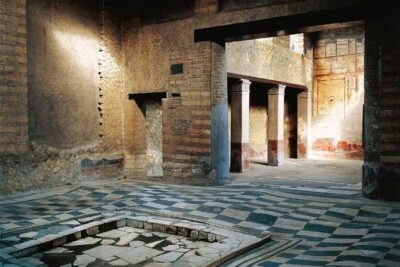
This domus is in the center of the archaeological area, with various environments, colonnati, and frescoes. It also includes charred remains of wooden parts, tying back into the theme of survival of materials.
The “grand portal” name fits because the focus is on a strong entrance and multiple internal spaces, so you get a bigger sense of the home’s overall layout even with a short stop.
Timing and how the day actually flows
The full experience is listed at about four hours. That number includes your private one-way transfer from Naples and the time spent in Herculaneum with the guide.
Inside Herculaneum, the stops are short, with most at 15 minutes, plus a brief entry orientation at about 10 minutes. The math works out to a tour structure built for speed: you’re seeing many major points rather than spending a long time at one location.
Here’s the practical way to think about it. If your ideal day is slow and you love studying details for a long time, you might want a longer Herculaneum visit. If your ideal day is efficient and you want a guided framework that keeps you from getting lost, this timing is a good match.
Also remember what the vehicle arrangement gives you. The driver stays with the vehicle while you tour. So you are not distracted by the worry of where to put things or how to carry bags safely.
When you finish the Herculaneum portion, the plan is to continue the one-way transfer to Positano, with hotel drop-off included. That is a big deal because you don’t have to figure out your next step in a busy place.
Price and value: what you’re really paying for
The price is $456.70 per person. That can feel steep at first glance, especially if you compare it to buying only transport.
But with this experience, you’re paying for several combined services:
- Private air-conditioned transfer from Naples to Positano
- A professional driver and luggage help
- A guided Herculaneum visit with an archaeologist guide
- Herculaneum entry tickets included (€16 each as part of the included items)
- Hotel drop-off in Positano
So the value isn’t only the ride. The ride is the easy part. The harder part is coordinating the move, managing arrival timing, and adding a guided visit that does not derail your travel day.
Another value factor is comfort and mental load. A private setup means fewer surprises, fewer waiting points, and no sprinting between bus schedules. That matters most when you’re traveling during popular hours on the Amalfi Coast.
Finally, there are group discounts listed with the tour. If you’re traveling with family or friends and can book as a small group, the per-person cost can feel more reasonable compared to piecing together separate tickets and transportation.
Who should book this (and who might want a different plan)
This experience is a great fit if:
- You want to get to Positano without dealing with the train and bus hassle
- You like the idea of pairing transportation with a structured guided ruin visit
- You prefer a private setup over sharing a van or crowding into public transit
It may be less ideal if:
- You want a long, slow Herculaneum museum-style visit
- You are okay with planning on your own and saving money by building your own route
Also, keep in mind that car seats are available on request, and service animals are allowed. If that matters for your family, this is a helpful detail.
One more note that can matter for planning: confirmation is received at booking time, and car seats can be requested. Plus, it’s listed as near public transportation, which can be useful as a backup plan in case of minor changes.
If you want to make this work smoothly, booking a few weeks ahead is smart. It’s described as often booked about 37 days in advance on average, so availability can be a factor closer to travel.
Should you book the Naples to Positano transfer with Herculaneum guide?
I’d book it if you have only one day to make progress along the Amalfi Coast and you don’t want your schedule controlled by transit connections. The combination of a comfortable private transfer plus a focused Herculaneum tour is exactly the kind of “time-saving, meaning-making” itinerary that works well in this region.
I’d think twice if you already know you want to spend half a day (or more) soaking in one ruin site without the pressure of a moving checklist. In that case, you might prefer a dedicated Herculaneum visit.
But if your goal is to move, see real Roman spaces, and leave Herculaneum understanding what you just toured, this format is strong. The high praise in the feedback points to two things that matter most in practice: a transfer that is on time and easy, and a guide who explains the details in a way you can actually carry with you into the rest of your day. In particular, Laura is named as an excellent guide for Roman history context.
FAQ
What is included in the Herculaneum visit?
Entrance tickets for Herculaneum are included, and you get a guide and assistance by a professional guide at Herculaneum. Transport by private air-conditioned minivan and hotel drop-off in Positano are also included.
Where do we meet the guide for Herculaneum?
You meet the guide at the ticket office of the Herculaneum ruins.
How long is the overall experience?
The total duration is listed as approximately 4 hours.
How long is the Herculaneum guided portion?
The experience includes a guided tour stop in Herculaneum described as a two-hour guided tour.
Is pickup available in Naples?
Yes. Pickup is offered, and you can choose the pickup time and location in Naples.
Do I need to pay separately for entry tickets?
No. Herculaneum entry tickets are included as part of the experience (listed as €16.00 each). The itinerary also lists several stops as admission ticket free within the visit.
Is this tour private?
Yes. It is a private tour/activity, and only your group participates.
Are meals included?
No. Meals are not included.
Are car seats available?
Car seats are available on request.
Can I bring a service animal?
Service animals are allowed.
What is the cancellation policy?
Free cancellation is available. You can cancel up to 24 hours in advance for a full refund.
More 2-Hour Experiences in Positano
- From Positano or Praiano: 2H Private Amalfi Coast speed tour
★ 4.5 · 9 reviews - 2 Hours Sunset Cruise of Positano
★ 5.0 · 5 reviews - Private Transfer-Positano to Naples with 2h of Sightseeing: Vesuvius or Pompeii
★ 5.0 · 1 review - 2 Hour Private Amalfi Coast Sunset Experience
★ 5.0 · 79 reviews
Private Drivers on the Coast
- Private Transfer from Positano to Naples
★ 5.0 · 87 reviews - Private Transfer From Positano Hotels to Naples
★ 5.0 · 50 reviews - Private Transfer from Positano to Naples
★ 5.0 · 40 reviews - Transfer from Positano to Naples
★ 5.0 · 34 reviews
Freshly added to the coast
- Vacation Photographer in Positano★ 5.0 · 1 review
- Private Tour of Pompeii with Wine Tasting & Lunch from Positano★ 5.0 · 1 review
- Sunrise Private Boat Tour from Positano, Praiano, Amalfi★ 5.0 · 1 review
- Path of the Gods from Agerola to Praiano – Amalfi Coast.★ 5.0 · 1 review
- Sorrento and Positano Tour★ 5.0 · 1 review
- Path of the Gods★ 5.0 · 1 review
- Luxury Positano and Capri private boat tour★ 5.0 · 1 review
Herculaneum Ruins Trips, compared.
Pompeii Herculaneum small group tour from AmalfiCoast
Read our review →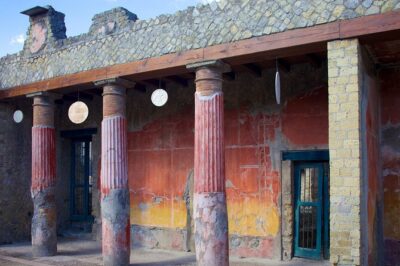
Half Day Herculaneum and Pompeii Tour from Positano
Read our review →
Transfer from Positano to Naples with a 1 hour stop in Pompeii or Herculaneum
Read our review →
Visit Pompeii and Herculaneum Excavations from Salerno
Read our review →Browse the lists this tour appears in