
Reviewed · PAESTUM TEMPLE TOURS
Paestum 3 Hours Archaeological Private Tour
Three hours in Paestum feels timeless. This private archaeological tour gives you a focused walk through Paestum’s best-known ruins with a licensed guide who turns stones into stories.
I especially love how the route mixes Greek Doric temples with Roman-era features, so you see how the site changed over time.
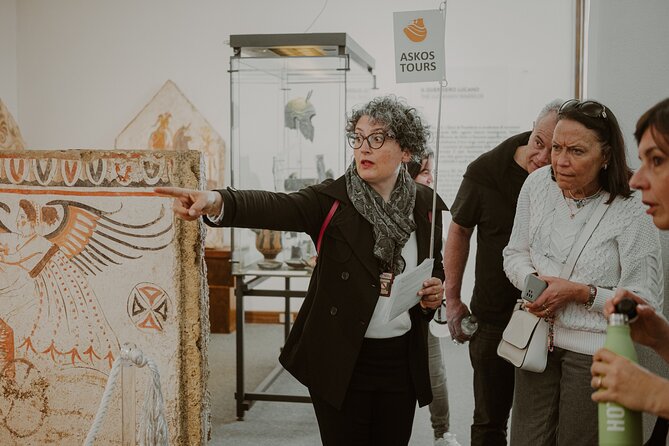
I also love the payoff at the National Archaeological Museum, where you get to connect the outdoor ruins to the artifacts that survive. The highlight for many people is the museum’s famous frescoed tomb, the Tomb of the Diver.
One drawback to plan for: it is a moderate walking tour in open-air ruins. If you are visiting in hot weather, bring water and expect the time outside to feel longer than the clock says.
In This Review
- Key highlights you can bank on
- Paestum in three hours, what you will really see
- Your 3-hour plan: temples, public spaces, then the museum payoff
- Temple of Poseidone or Neptunus, but it is really Hera II
- Temple of Athena and the Temple of Ceres, how one footprint tells two stories
- Tempio di Hera II, also called the Basilica, the oldest major anchor
- Roman amphitheater, the Heroon, and the Greek hall where assemblies happened
- National Archaeological Museum of Paestum, where the Tomb of the Diver hits hardest
- Guides matter: passion, clarity, and how they handle tough conditions
- Price and value: $254.43 per person for a focused private format
- Practical stuff that helps: meeting point, shoes, and time in the sun
- Who this tour suits best
- Should you book this Paestum 3 Hours Archaeological Private Tour?
- FAQ
- How long is the Paestum 3 Hours Archaeological Private Tour?
- What is the starting meeting point for the tour?
- Is the tour private?
- What is included in the price?
- What is not included?
- Are admission tickets included for the sites and the museum?
- What kind of physical effort should I expect?
- Can I cancel for a full refund?
Key highlights you can bank on
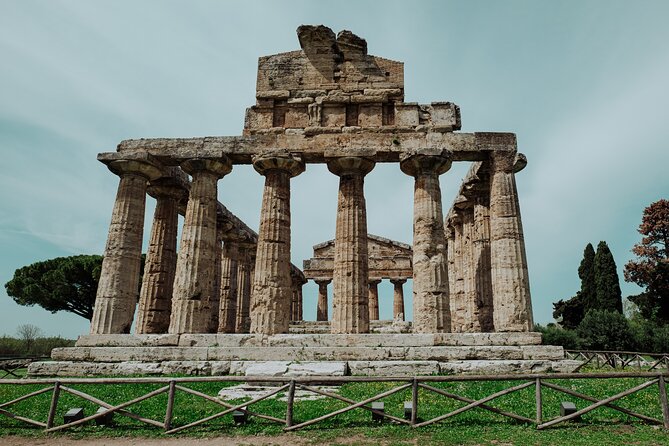
- Doric temples at Paestum: you get the big three in a tight, guided 3-hour format
- Temple mix-up explained: the so-called Temple of Poseidon is really the Temple of Hera II
- Roman amphitheater detail: the seating area was reshaped, and a road cut through it in 1829
- Greek assembly hall stop: the Ekklesiasterion shows how citizens met and voted
- Museum with a star attraction: the Tomb of the Diver fresco is a must-see
- Guides who work the room: guides named Marco and Ivan Tornese are praised for passion and making the visit feel personal
Greek temples older than the coast road
- Paestum Small Group Tour with an Archaeologist
★ 5.0 · 189 reviews - Paestum: Private Tour of Greek Temples and Archaeological Museum
★ 5.0 · 60 reviews - Paestum Traditions, Buffaloes, Ceramics, Temples
★ 5.0 · 24 reviews - Tour at the Temples and the National Museum of Paestum
★ 5.0 · 16 reviews
Paestum in three hours, what you will really see
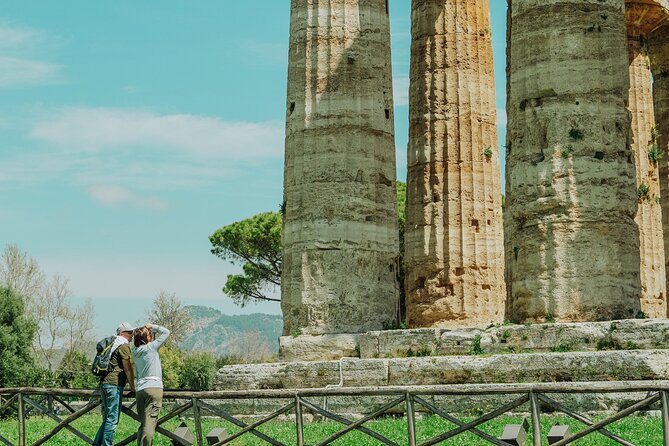
Paestum is in the northern Cilento area of Italy, not far from the Sele River and the Tyrrhenian Sea. The city originally began as Poseidonia, and over centuries it absorbed new rulers and new building styles.
This tour is built for people who want the essentials without turning it into an all-day project. In about three hours, you walk the archaeological park, then switch gears to the museum.
What you will feel most is how Paestum teaches time. You start with monumental Greek architecture, then you spot Roman layers, then you finish with artifacts that help you “read” what you just saw.
Your 3-hour plan: temples, public spaces, then the museum payoff
The pacing is straightforward. You begin in the Archaeological Park of Paestum with a licensed archaeological guide, then you move through the major temple areas and public buildings.
After the outdoor route, you spend about one hour at the National Archaeological Museum. That museum time matters because it turns your visit from looking at ruins to understanding them.
Most stops are short, around 15 to 30 minutes. That is not a bad thing here. Paestum is meant to be seen with guidance that points out what to notice first, where to stand, and what each structure likely meant.
Temple of Poseidone or Neptunus, but it is really Hera II
One early stop is the famous Temple of Poseidone O Nettuno. You will see it referred to by multiple names, because people long ago misidentified the temple.
Here is the useful takeaway: this temple is earlier and is often still called the Temple of Poseidon due to that old confusion. Your guide can help you sort myth from archaeology, and that alone is worth paying attention to.
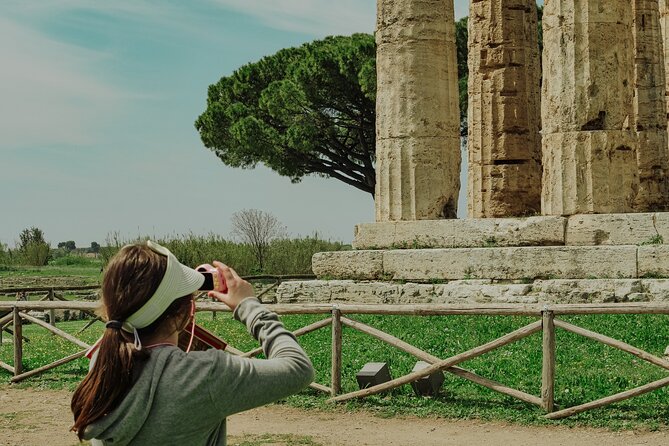
When you stand near it, focus on the Doric columns and the clean, geometric feel of the building. Doric architecture is all about proportion and restraint, and Paestum does it with impressive clarity.
A consideration: because this is a monumental outdoor stop, light and heat can make it tiring to stare up at details. If you get sweaty, just alternate, look up for a minute, then look across the row of columns to reset your eyes.
Temple of Athena and the Temple of Ceres, how one footprint tells two stories
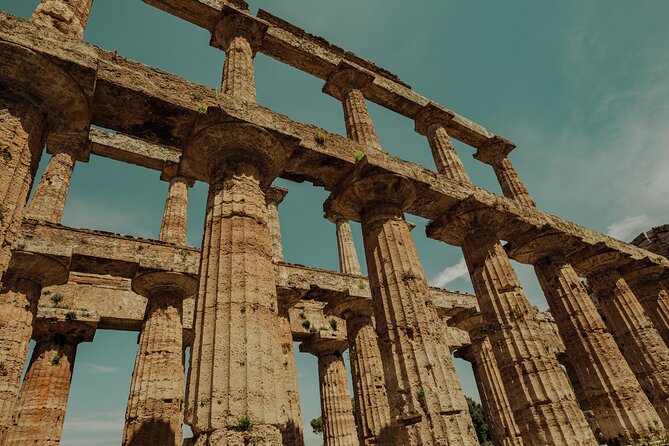
Next you move to the Temple of Athena, sometimes also labeled the Temple of Ceres. The guide’s job is to connect the structure you see with its likely historical timeframe.
This temple is around 500 BC and sits near a much larger complex called the Basilica area. That relationship is important. It shows you that this was not a random scatter of buildings. It was a designed civic and religious space.
Look for how the temple’s position helps you understand the layout of the whole park. Even if you only have a short stop, the sense of how the religious buildings relate to the bigger zone is what makes it stick.
Other ways to see the Amalfi Coast
- Private Boat Excursion to the Amalfi Coast★ 5.0 · 142 reviews
- Private Boat Tour along the Amalfi Coast or Capri★ 5.0 · 141 reviews
- Private boat tour of the Amalfi coast or Capri★ 5.0 · 106 reviews
Tempio di Hera II, also called the Basilica, the oldest major anchor
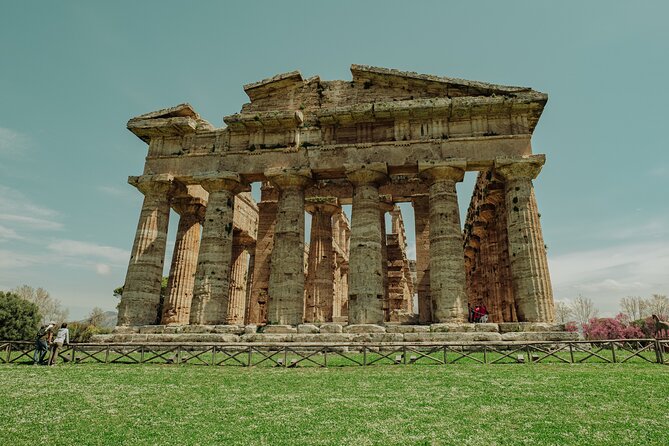
Then comes the Temple of Hera II, also known as the Basilica. This is the oldest of Paestum’s three major temple buildings, with construction begun around 560 BC.
This is one of the moments where a guide helps most. Without context, you might just admire the columns. With context, you start noticing how the building represents an early generation of large stone temples.
Spend your attention on the overall structure rather than trying to memorize every carved detail. The size, the symmetry, and the way the building sits in its area tell you a lot.
If you have limited time in Paestum, this is one you do not want to rush. The tour gives you a short window, but it is enough to get the meaning if you follow your guide’s cues.
Roman amphitheater, the Heroon, and the Greek hall where assemblies happened
Paestum is not only Greek temples. The tour includes a Roman amphitheater near the Forum.
The key detail here is how the amphitheater evolved. It dates to the late Republican era and was modified in the 2nd century AD. Later, in 1829, a road split the amphitheater seating area. That is a great lesson in how real places keep changing long after the ancient builders stop working.
After that, you go behind the Forum for the Heroon. This structure was built between the 1st century BC and the 1st century AD. Recent excavations suggest it may have been the site of the Greek agora, which means the place where people gathered for civic life.
Then you reach the Ekklesiasterion of Paestum, a Greek assembly hall. This is one of those stops that makes the ruins feel human. You are not just looking at religious monuments. You are looking at the architecture tied to meetings and decision-making.
If you like “how did people live” history, you will enjoy this trio. It gives you more than monuments. It gives you spaces where communities acted.
National Archaeological Museum of Paestum, where the Tomb of the Diver hits hardest
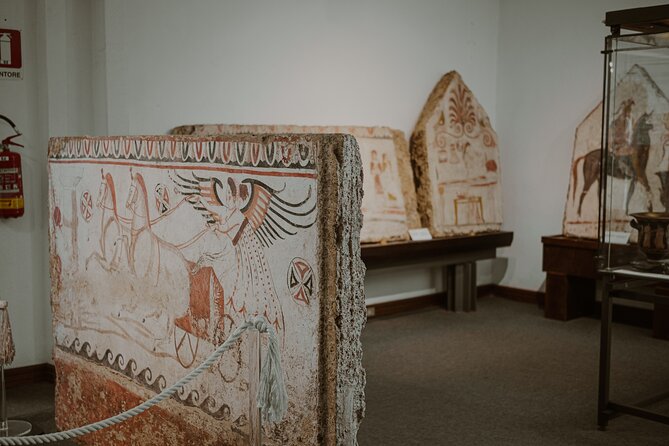
At the museum, you get about one hour, with admission included. This is the place where Paestum shifts from architecture to objects, art, and burial symbolism.
The museum is known for Greek and Roman artifacts, and it contains the famous Tomb of the Diver, a 5th-century BC frescoed tomb. The fresco is known for its striking imagery, and it is often treated as one of the museum’s signature works.
Why this museum stop is such good value: it gives your eyes context. After walking past temples and civic spaces, you can connect what you saw outside with the art and material culture inside.
A practical tip: if you are prone to rushing, slow down here. The museum’s standout works reward time. Use your guide’s prompts to find the pieces that connect directly to Paestum’s cultural mix.
Guides matter: passion, clarity, and how they handle tough conditions
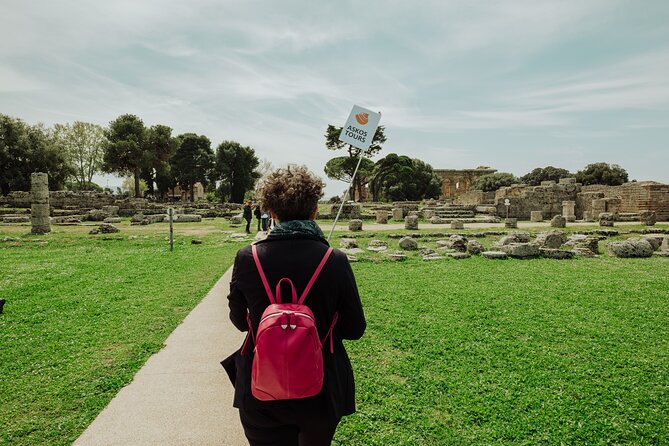
This tour is private, which means your guide can adjust pacing to your group. That matters in Paestum because the sites are spread out just enough to make timing feel tight.
The guide experience comes through in the way people describe it. One visitor highlighted Marco as prepared and passionate, and praised his ability to answer curiosity during the visit even with intense heat. Another described Ivan Tornese as expert and empathetic, turning a morning among excavations and museum displays into a trip back in time.
A balanced note: the guide is the product here. If a guide cancels last minute, it can disrupt plans. One experience involved a cancellation less than a day before the scheduled tour due to guide unavailability, though the company offered to reschedule. If you are traveling with strict constraints, build in a bit of flexibility.
Price and value: $254.43 per person for a focused private format
At $254.43 per person for about three hours, this is not a budget stroll. But it can be strong value if you care about having an expert point out what you would otherwise miss.
Here is why the pricing can work: admission fees are included, and you get a certified archaeological guide for the full duration. You are also getting a route that covers major structures plus a museum visit, instead of paying for separate tickets and separate explanations.
It is also a private tour with group discounts. If you are traveling as a pair or small group, the per-person value can become more attractive, especially compared with mixing private guiding with museum entry tickets on your own.
A simple way to decide: if you like learning, want context, and would otherwise skim the ruins, paying for guidance usually pays you back. If you mostly enjoy reading labels at your own pace and you already know Paestum well, you might spend less going independently. But for most people, having someone steer your attention is the difference between seeing temples and understanding them.
Practical stuff that helps: meeting point, shoes, and time in the sun
The tour meets at Via Magna Graecia, 919, 84047 Santa Venere SA, Italy, and it ends back at the meeting point. The meeting spot is near public transportation, so it is easier to line up if you are already using local transit.
Comfortable shoes are strongly recommended. Paestum involves walking in archaeological areas, and the tour is rated as moderate physical fitness.
Also plan for time outdoors. Even if each stop is short, the total sun exposure can wear you down. Bring water, wear a hat if you can, and consider light layers. Your guide can keep things moving, but the environment sets the pace.
Who this tour suits best
I think this works especially well if you want a clear, guided arc. You like temples, but you also want the civic and Roman parts, not just the postcard columns.
It is a smart fit for people who:
- want a tight timeline and not an all-day outing
- prefer a guide who explains what you are seeing in real time
- enjoy the museum connection, not only outdoor ruins
- are traveling with someone who might get bored without context
If you are traveling with very young kids or if you need very slow movement, the moderate walking and short stop rhythm may feel fast. In that case, you might want to ask the provider about pacing options before committing.
Should you book this Paestum 3 Hours Archaeological Private Tour?
If your goal is a guided introduction to Paestum that actually connects the temples to civic life and then to museum artifacts, I would book it. The combination of the major ruins with museum time and included admission is a practical way to get your money’s worth.
I would hesitate only if your schedule has no wiggle room. A rare last-minute guide cancellation can happen, and Paestum is timed to your visit window. If you can stay flexible, that risk shrinks.
For most travelers, the real reason to book is the guide-led attention. Paestum is easy to look at and harder to understand, and that is exactly where a certified archaeological guide earns their fee.
FAQ
How long is the Paestum 3 Hours Archaeological Private Tour?
It lasts about 3 hours.
What is the starting meeting point for the tour?
The tour starts at Via Magna Graecia, 919, 84047 Santa Venere SA, Italy.
Is the tour private?
Yes. It is a private tour/activity, and only your group participates.
What is included in the price?
The tour includes guidance and assistance for the entire duration by a certified archaeological guide, and admission fees.
What is not included?
Transportation and meals are not included.
Are admission tickets included for the sites and the museum?
Yes. Admission fees are included, and the tour indicates admission tickets for the archaeological park and that the museum stop is included with ticket access.
What kind of physical effort should I expect?
The activity level is moderate. Comfortable shoes are recommended, and you should have a moderate physical fitness level.
Can I cancel for a full refund?
Yes. Free cancellation is available up to 24 hours in advance for a full refund.
Freshly added to the coast
- Amalfi Coast Hike and Wine Tour in Vietri★ 5.0 · 1 review
- Boat Tour to Capri with visits to the Island, Caves, Faraglioni★ 5.0 · 1 review
- Paestum Temples and Mozzarella Experience★ 5.0 · 1 review
- 4-hour boat tour of the Amalfi Coast & Li Galli Islands★ 4.0 · 1 review
- Amalfi Coast by Private Boat – Full-Day High-End Coastal Escape★ 5.0 · 1 review
- Amalfi Coast to Rome with stop at Pompeii or Vice Versa★ 5.0 · 1 review
- Small Group Market tour and Cooking class in Vietri Sul Mare★ 5.0 · 1 review
Paestum Temple Tours, compared.
Paestum Small Group Tour with an Archaeologist
Read our review →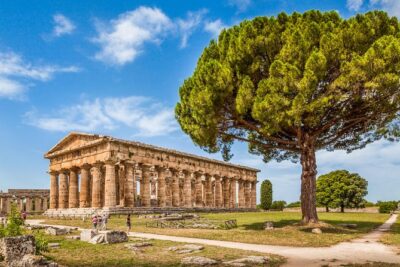
Paestum: Private Tour of Greek Temples and Archaeological Museum
Read our review →
Paestum Traditions, Buffaloes, Ceramics, Temples
Read our review →
Tour at the Temples and the National Museum of Paestum
Read our review →
Private Tour: Explore Paestum with an Expert Archaeologist
Read our review →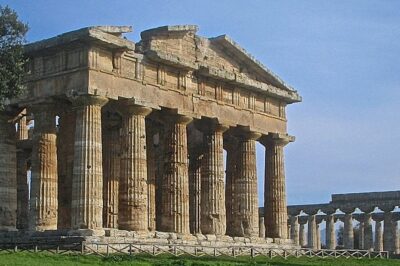

Private guided tour of Paestum and Buffalo Mozzarella farm lunch
Read our review →
Browse the lists this tour appears in